
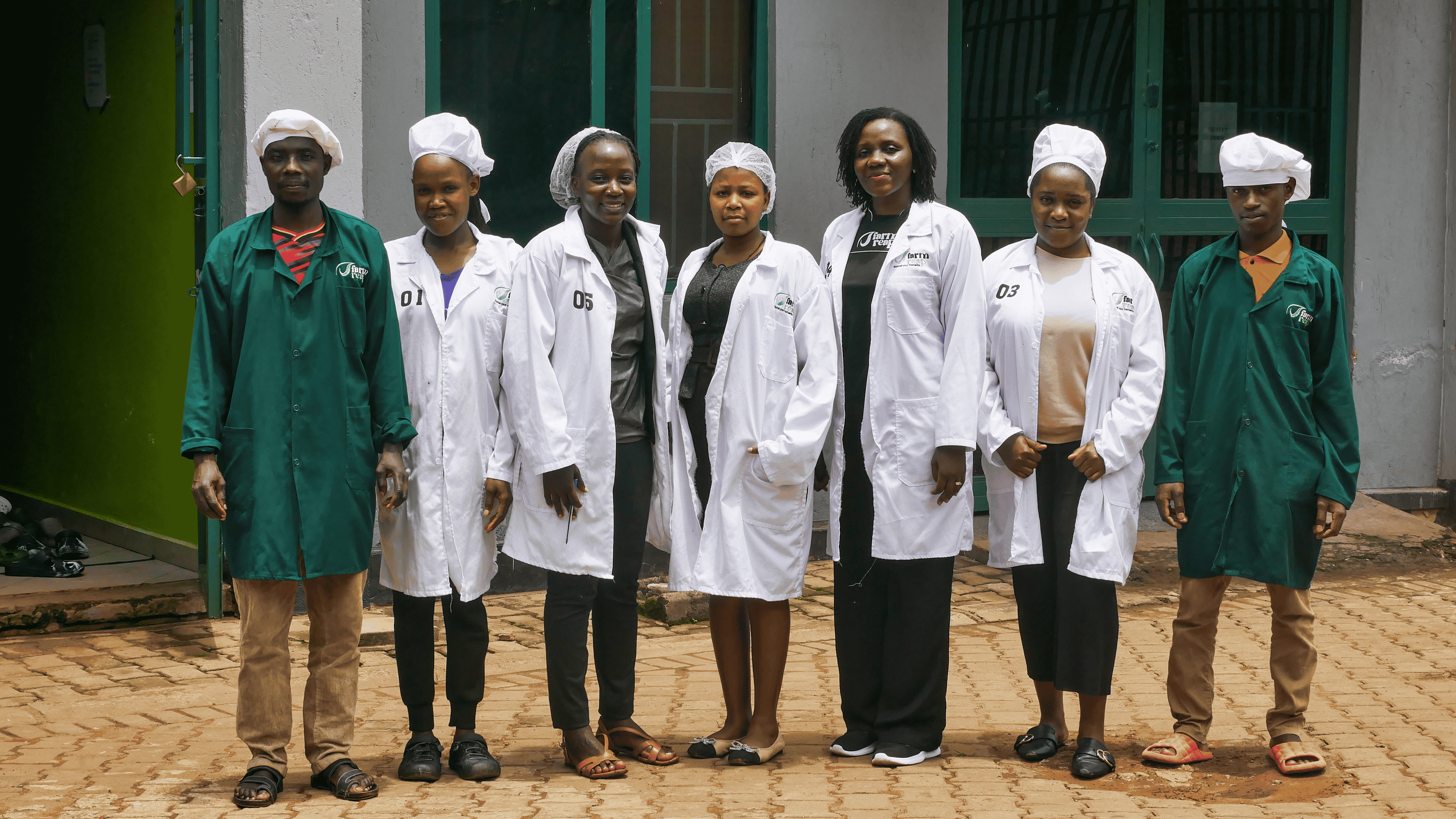
Farm Reap is a women-led yoghurt producer supplying Kampala, Wakiso and Mukono in Uganda, through supermarkets and kiosks, with a product that has already earned strong market acceptance. As the business began transitioning into larger retail spaces, growth was underway but the systems to sustain that growth were still catching up.
At this critical expansion stage, Farm Reap needed to better understand its markets, refine its distribution channels, strengthen its messaging, and address operational gaps including cooling and brand positioning. The ambition was clear: scale the business, improve profitability, compete among leading yoghurt suppliers, and contribute to improved nutrition. However, discrepancies in financial planning, evolving market realities, and the onset of COVID-19exposed structural weaknesses that required urgent attention.
The engagement therefore focused on strengthening both the commercial model and the organisational foundations of the enterprise. Through a comprehensive marketing and distribution diagnostic, customer and competitor analysis, financial modelling, and operational review, key constraints were identified and prioritised. Structured B2C delivery was introduced alongside supermarket partnerships to maintain revenue during lockdown. Brand and packaging systems were refined, governance and financial oversight strengthened, and cold-chain improvements explored to enhance product reliability.
The result was a clearer market focus, improved cash-flow management, and a more resilient route-to-market strategy, positioning Farm Reap not only to stabilise during disruption but to move forward with a structured, investable growth plan centred on brand consolidation and cold-chain expansion.
By the time support began, Farm Reap had proven its product-market fit. Customers loved the yoghurt. Supermarkets were interested. Yet operational strain was increasing.
The business was heavily dependent on bulk institutional buyers. Payments were often delayed, putting pressure on cashflow and limiting reinvestment capacity. When COVID-19 disrupted supply chains and purchasing patterns, this vulnerability became clear. Institutional demand dropped. Collections slowed. Uncertainty rose.
At the same time, cold chain management posed ongoing risks. Without optimized transport cooling and structured distribution routes, spoilage could quietly erode margins. Marketing relied largely on traditional methods, with digital channels underutilized despite growing consumer behavior shifts toward online discovery and ordering.
Internally, forecasting and financial planning tools required strengthening to enable confident scaling and external funding readiness.
In essence, Farm Reap had momentum but lacked the systems to protect and multiply it.
The engagement began with a structured diagnostic across marketing, distribution, operations, and financial systems. Rather than offering generic advice, the process focused on understanding Farm Reap’s specific bottlenecks and long-term ambitions.
Together, the teams developed a Marketing and Distribution Strategy that clarified target markets, pricing structures, positioning, and retail entry pathways. The support emphasized strengthening supermarket relationships while diversifying revenue streams.
A pivotal moment came during COVID-19 disruptions. With institutional buyers slowing down, the strategy pivoted toward direct-to-consumer (B2C) sales. Farm Reap activated Instagram and WhatsApp ordering, allowing customers to purchase directly. This shift transformed the company’s cash flow dynamics. Instead of waiting extended periods for bulk payments, the business began receiving immediate payments from individual customers.
Operationally, improvements were made to cold chain management, including structured use of cool boxes and more deliberate distribution planning. While spoilage figures were not formally documented, the CEO confirmed that the issue has since been effectively managed through these adjustments.
Financially, forecasting templates and structured planning tools were introduced. These improvements enhanced internal decision-making and strengthened the company’s readiness to pursue external funding.
The work was not about quick fixes. It was about building disciplined growth systems.
The outcomes reflect both resilience and structured improvement.
Production went up to 500 litres per day, now supported by more intentional market coverage and diversified channels.
The business employs over 15 staff members, contributing directly to job creation and household income stability.
The digital pivot was particularly transformative. Direct-to-consumer sales improved cashflow stability and reduced dependence on delayed institutional payments. Supermarket penetration expanded across Kampala, Wakiso, Entebbe, Mukono, and Luwero, strengthening brand visibility and regional presence.
An important learning emerged: scale without systems creates stress. Systems before scale create stability.
The experience reinforced that SMEs often do not fail because of poor products, they struggle because growth outpaces operational structure. Addressing distribution planning, cold chain management, and financial forecasting early protects future expansion.

The strengthened operational model has enabled Farm Reap to move forward with confidence rather than caution.
With improved distribution systems and digital channels, the business has expanded market access for nutritious dairy products. Families across central Uganda now access locally produced yoghurt more reliably.
Employment stability has been maintained, with over six team members directly supported by the business. Beyond jobs, the ripple effect includes dairy suppliers, retail partners, and local logistics actors.
The strengthened financial position and business clarity also positioned Farm Reap to secure USD 50,000 in funding. This capital has supported scaling, working capital stability, and broader operational resilience.
Following the strengthening of internal systems and strategic positioning, Farm Reap secured $50,000 USD in funding. The CEO attributes this to improved financial clarity and structured growth planning.
The funding has enabled continued production at 500 litres per day while supporting operational stability and expansion. It has strengthened the company’s ability to manage working capital, improve distribution, and plan forward with greater confidence.
Reflecting on the journey, Sylvia Natkunda speaks candidly about the transformation.
She explains that before restructuring, the business was operating with momentum but without protective systems. COVID-19 exposed the vulnerability of relying too heavily on institutional buyers. When payments delayed and demand fluctuated, cash flow tightened.
The decision to pivot toward business-to-consumer (B2C) sales through online engagement (Instagram and WhatsApp) changed the company’s trajectory. Instead of waiting months for institutional payments, customers paid instantly. Cash flow stabilized. Confidence returned.
She also emphasizes how structured forecasting improved internal discipline. Decisions were no longer based on assumptions but guided by projections and clearer financial visibility. That clarity strengthened conversations with funders and investors, ultimately contributing to securing USD 50,000 in funding.
Farm Reap is no longer simply growing. It is growing intentionally.

“We wanted Challenges Uganda to review our marketing and distribution strategy and then recommend some key strategies that we could adopt. They came with a deep understanding of who our clients were. I got more technical support, and went on to prepare my pitches which later led to getting some funding. I was more prepared. I knew more about my business, which was easy to defend, easy to talk about, like clarity of vision, mission, customers, and everything.” — Sylvia Natkunda, CEO and Founder, Farm Reap


